الجمعة، 14 يناير 2011

الخميس، 13 يناير 2011
الأربعاء، 12 يناير 2011
PROFILE: Wikipedia founder Jimmy Wales - share the knowledge
Jimmy Wales is constantly on the go. Most of the year he travels round the globe. His mission? To make all human knowledge accessible to everyone.
"Wikipedia is going to be increasingly global in the future," the 44-year-old American says. "We will have enormous growth in the developing world." It was 10 years ago, in January 2001, that he launched the online encyclopedia. Now, ten years later, it offers 17 million entries in more than 260 languages.
"Wikipedia is going to be increasingly global in the future," the 44-year-old American says. "We will have enormous growth in the developing world." It was 10 years ago, in January 2001, that he launched the online encyclopedia. Now, ten years later, it offers 17 million entries in more than 260 languages.
Wales was born in 1966 in Alabama. His father was a grocery store manager and his mother an educator. Even as a boy he had an unquenchable thirst for knowledge and "spent lots of hours" reading the Britannica and World Book Encyclopedia.
His earliest education was at home from his own mother, who ran a small private school on the Montessori method. Later Jimbo, as friends call him, got a master's degree in finance and worked as the research director of a Chicago futures and options firm for several years.
His driving passion is computers. Since the earliest days of personal computing he has been an Internet addict and even wrote computer codes as a hobby, according to his own biographical entry on Wikipedia.
In 1996, he and two partners founded Bomis, a men's web portal featuring entertainment and adult content. This website provided the initial funding for the peer-reviewed encyclopedia Nupedia in 2000.
Thanks to the Wiki software, which enables each user immediate access -- as author or as editor -- Wikipedia was founded the following year.
Today Wikipedia resembles pretty much what he originally envisioned, he told the German Press Agency dpa in an interview.
"But of course it's a lot larger and more popular than I had ever imagined," he said.
So can we say that Wikipedia has made the world different and has made Wales a rich man? "I hope that the world has become a little better." And as for the financial side. "The pages are non-commercial and they will stay that way," Wales explained. But his for-profit Internet company Wikia is doing well and shows a profit.
"That may make me rich!" he said.
Wales is a self-avowed "Objectivist to the core", Objectivism being an individualist philosophy developed by writer Ayn Rand. And he is an avid chess player.
He is separated from his second wife, with whom he has a daughter. Although 10-year-old Kira consults Wikipedia on occasion, her father favours traditional education.
"Anybody who says you don't need to know anything these days, just know where to look it up, is mistaken, in my opinion," he said.
And Wales himself still loves to pore over books just as he did when he was a boy.
"Books are great. They're inexpensive and the batteries never run down," he said.
To see more of dpa, go to http://www.dpa.de/English.82.0.html Copyright (c) 2011, dpa, Berlin Distributed by McClatchy-Tribune Information Services. For more information about the content services offered by McClatchy-Tribune Information Services (MCT)
His earliest education was at home from his own mother, who ran a small private school on the Montessori method. Later Jimbo, as friends call him, got a master's degree in finance and worked as the research director of a Chicago futures and options firm for several years.
His driving passion is computers. Since the earliest days of personal computing he has been an Internet addict and even wrote computer codes as a hobby, according to his own biographical entry on Wikipedia.
In 1996, he and two partners founded Bomis, a men's web portal featuring entertainment and adult content. This website provided the initial funding for the peer-reviewed encyclopedia Nupedia in 2000.
Thanks to the Wiki software, which enables each user immediate access -- as author or as editor -- Wikipedia was founded the following year.
Today Wikipedia resembles pretty much what he originally envisioned, he told the German Press Agency dpa in an interview.
"But of course it's a lot larger and more popular than I had ever imagined," he said.
So can we say that Wikipedia has made the world different and has made Wales a rich man? "I hope that the world has become a little better." And as for the financial side. "The pages are non-commercial and they will stay that way," Wales explained. But his for-profit Internet company Wikia is doing well and shows a profit.
"That may make me rich!" he said.
Wales is a self-avowed "Objectivist to the core", Objectivism being an individualist philosophy developed by writer Ayn Rand. And he is an avid chess player.
He is separated from his second wife, with whom he has a daughter. Although 10-year-old Kira consults Wikipedia on occasion, her father favours traditional education.
"Anybody who says you don't need to know anything these days, just know where to look it up, is mistaken, in my opinion," he said.
And Wales himself still loves to pore over books just as he did when he was a boy.
"Books are great. They're inexpensive and the batteries never run down," he said.
To see more of dpa, go to http://www.dpa.de/English.82.0.html Copyright (c) 2011, dpa, Berlin Distributed by McClatchy-Tribune Information Services. For more information about the content services offered by McClatchy-Tribune Information Services (MCT)
Sony launches legal action against PlayStation hackers
Sony has launched legal action against hackers who uncovered and published security codes for the PlayStation 3.
The hack potentially allows anyone to run any software on their machine, including pirated games.
Sony's lawsuit argues that this constitutes copyright infringement and computer fraud.
But George Hotz, one of the hackers at the centre of the controversy, told BBC News that he was "comfortable" the action would not succeed.
"I am a firm believer in digital rights," Mr Hotz said.
"I would expect a company that prides itself on intellectual property to be well versed in the provisions of the law, so I am disappointed in Sony's current action.
"I have spoken with legal counsel and I feel comfortable that Sony's action against me doesn't have any basis."
The twenty-one-year-old, who rose to prominence for breaking the iPhone's security, is named in the lawsuit alongside more than 100 people associated with a hacking group known as fail0verflow.
Continue reading the main story
“Start Quote
End Quote Court filingAlready, pirate video games are being packaged and distributed with these circumvention devices.”
In the filing, submitted to the Northern District Court of California, Sony asks for a restraining order that bans Mr Hotz from further hacking and prevents distribution of the software produced as a result.
"Working individually and in concert with one another, the defendants recently bypassed effective technological protection measures employed by Sony," the document states.
"Through the internet, defendants are distributing software, tools and instructions that circumvent the [protection measures] and facilitate the counterfeiting of video games. Already, pirate video games are being packaged and distributed with these circumvention devices."
Secret codes The controversy centres around a series of secret codes that Sony uses to protect its system from being used for unauthorised purposes.
Among them is a number used to "sign" all PS3 games and software as a way of proving that they are genuine.
Once the key is known, however, it can be used to sign any software - including unofficial software and, potentially, pirated games.
The PlayStation's protection had remained impenetrable for several years, but members of fail0verflow demonstrated the first breakthrough in December when they presented a security exploit at the Chaos Communication Congress in Berlin.
Mr Hotz then revealed that he had uncovered the secret signing number using a similar method.
fail0verflow's website was taken down overnight, replaced with the message "Sony sued us" and a brief statement.
"We have never condoned, supported, approved of or encouraged videogame piracy," it says.
"We have not published any encryption or signing keys. We have not published any Sony code, or code derived from Sony's code."
The group has said in the past that it is vehemently against games piracy and that it had worked on the hack so that users could install other operating systems and amateur software on the console.
Sony had indicated previously that it would try to fix the hack by updating the PS3's software over the internet.
Console hacking and online copyright infringement is a contentious topic, frequently ending in high-profile court cases as technology companies seek to prevent their systems from being copied or modified.
While most cases in recent years have involved music and video file-sharing services like Napster, Grokster and Kazaa, a growing number of cases have involved the hacking of video games consoles.
Last year, a team released a piece of hardware called PSjailbreak that allowed gamers to play homemade and pirated games on the PlayStation 3.
Although the company has issued software to block the device and launched legal action, it has not prevented it entirely - with a Spanish court ruling that the gadget is not illegal.
In December, meanwhile, federal prosecutors dropped their case against a student accused of pirating games for Microsoft's Xbox 360.
The case against California resident Matthew Crippen was dropped after the judge said that he had "serious concerns" about the legality of the evidence collected against him.
Inside the Computer History Museum's Stunning Exhibit
This Thursday, the Computer History Museum in Mountain View will unveil "R:Evolution," a $19 million renovation focusing on the first 2,000 years of computing. And it's amazing.
Reporters were invited to tour the facility in advance of the formal grand opening later this week. About 100,000 artifacts are spread across 19 galleries - with more in storage - each devoted to a different subject - the topics include video games, mainframes, logic, and much more.
According to John C. Hollar, the president of the museum, the expansion makes the museum the "leading institution in the field," he claimed. Funding was provided by Bill Gates and many other donors.
Although the Computer History Museum has been in existence for about 30 years, it only arrived in Silicon Valley in 2002, when it moved from an exhibit in Digital Equipment Corp.'s headquarters to the former executive briefing center of SGI, which it now owns.
"We are trying to construct an institution that will live forever, that will be around 100 years from now, and will tell the story of computer history that's not over yet," Hollar said.
The museum invited computing celebrities including Frances Allen, an IBM fellow who pioneered work in optimizing compilers; Al Alcorn, the co-founder of Atari; Don Knuth, who authored a seminal work on software; and Steve Wozniak, the iconic co-founder of Apple. In an interview, Wozniak revealed that he owns and uses three iPhones, and will buy a "VeriPhone" as well.
I had the privilege of touring parts of the museum, where I literally got lost among the exhibits. If you go - and I recommend you do - expect to see virtually all of the devices that shaped the technology industry, including many you probably had no idea existed.
Let me be clear - if you are an avid PC Magazine reader, you owe it to yourself to spend a day at the museum.
I spent an hour or more taking way too many photographs, as just a teaser of what to expect. There's some great stuff there - Pixar computers, Russian PC knockoffs, the Apple Pippin, police robots - so please check out the associated slideshow.
And when you're done, check out how a motherboard is made and the London retrospective exhibit on video games.
Reporters were invited to tour the facility in advance of the formal grand opening later this week. About 100,000 artifacts are spread across 19 galleries - with more in storage - each devoted to a different subject - the topics include video games, mainframes, logic, and much more.
According to John C. Hollar, the president of the museum, the expansion makes the museum the "leading institution in the field," he claimed. Funding was provided by Bill Gates and many other donors.
Although the Computer History Museum has been in existence for about 30 years, it only arrived in Silicon Valley in 2002, when it moved from an exhibit in Digital Equipment Corp.'s headquarters to the former executive briefing center of SGI, which it now owns.
"We are trying to construct an institution that will live forever, that will be around 100 years from now, and will tell the story of computer history that's not over yet," Hollar said.
The museum invited computing celebrities including Frances Allen, an IBM fellow who pioneered work in optimizing compilers; Al Alcorn, the co-founder of Atari; Don Knuth, who authored a seminal work on software; and Steve Wozniak, the iconic co-founder of Apple. In an interview, Wozniak revealed that he owns and uses three iPhones, and will buy a "VeriPhone" as well.
I had the privilege of touring parts of the museum, where I literally got lost among the exhibits. If you go - and I recommend you do - expect to see virtually all of the devices that shaped the technology industry, including many you probably had no idea existed.
Let me be clear - if you are an avid PC Magazine reader, you owe it to yourself to spend a day at the museum.
I spent an hour or more taking way too many photographs, as just a teaser of what to expect. There's some great stuff there - Pixar computers, Russian PC knockoffs, the Apple Pippin, police robots - so please check out the associated slideshow.
And when you're done, check out how a motherboard is made and the London retrospective exhibit on video games.
CES Tablet Extravaganza: Motorola, RIM, Toshiba & Asus Stand Out
CES provided a tableau of what buyers can expect in tablets, nearly all of them evolutionary hardware improvements over the currently-shipping iPad, none of them available now, and most of them, predictably, clones. Here's a guide, based on a modest round of discussions and demonstrations at a frenzied CES; videos included where appropriate.
The tablet tease is finally over. Even if nothing new has shipped, if pricing and availability have yet to be revealed, if mobile operators are still being courted, and if a viable underlying tablet platform (besides iOS) has yet to be made available, there is little left to learn, other than the answer to that pesky question about which device will dare challenge Apple's relentless success, or at least emerge as the leading also-ran. Motorola is the early favorite, but there are equally compelling competitors, including Asus, Toshiba and RIM; and a few cool twists, like dual-screen devices, slide-out keyboards, and 4G connectivity.
Most new tablets will run Android, but since Google hasn't shipped version 3.0 (aka Honeycomb) -- the version that promises a better tablet experience -- it's best to focus on hardware. The iPad exceeded consumer expectations despite plenty of griping about what else should have been possible (like cameras). Almost a year in and there's no sign the device is wearing around the edges. But the next wave of tablets does offer significant hardware improvement: dual-core processors (1 GHz), both front and rear-facing cameras (the latter at 5 megapixels; 2 megapixels for the former), 1GB of RAM and at least 16GB of storage (how useful more storage will be in a web application world can be our next debate), USB (mini and regular) and mini HDMI (for video out). Hold out for everything.Size matters. Certainly content consumption is possible -- even acceptable -- at seven inches, which fits even the smallest hand. Ten inches is better where web browsing and video viewing is constant. We saw 8 and 12 inch devices as well. But size comes down to buyer preference. It's also likely that Honeycomb will allow developers to detect and adjust for screen size and resolution.
None of the newly-announced devices ship now; some don't even exist. Most will wait for Honeycomb. Buyers would be wise to do the same (and wait for whatever Apple has next). It wouldn't hurt to take a closer look at RIM, whose seven-inch PlayBook is likely a prelude to other form factors (video demonstration below); nor would it hurt to hear what HP (Palm) is expected to unveil next month.
The Clones
Beyond that, buying a tablet is going to be like buying a PC: brand preference will matter, and feature differences will seem insignificant. Price will factor heavily.
Motorola Xoom. Motorola is regaining its footing with a slew of popular Android phones, and that momentum has carried over into Xoom, its new tablet. That's great news for Motorola, and certainly its offering is plenty packed with all the right hardware, although the 512MB of RAM is half of what most of the other devices carry -- indeed, half of what Motorola's new 4G phone will provide. Motorola was the only company with an early build of Honeycomb -- a somewhat meaningless achievement, unless garnering headlines or being "first" matters that much. By the time all of the latest tablets actually start to ship, Honeycomb will be shipping and all of the tablets will run it.
That the Xoom is upgradeable to 4G (in Q2) is compelling, but the rest of what it offers depends on Honeycomb -- the 3D Maps, the video chat, and the ability to create your own widgets, for example. Motorola was only demonstrating a pre-recorded video of Honeycomb, anyway.
Motorola also demonstrated its Atrix "virtual laptop" (a laptop dock, which the company calls a "webtop") powered by the company's new Atrix 4G phone; if the Xoom can also power the Webtop, the role of the laptop could well become scrutinized, especially considering that you can run virtual sessions using a Citrix Receiver client. Others are also offering the laptop/docking functionality.
4G Wireless Evolution - Verizon iPhone Could Spell Trouble for Android-Based Handset Manufacturers
After months of reporting on rumors, hearsay, conjecture and even gossip, we can finally tell you that Verizon (News  - Alert) will begin carrying the iPhone in February.
- Alert) will begin carrying the iPhone in February. 
While the carrier's Tuesday press conference cleared up one long-unanswered question, it also provides us with a host of others. One of which being: How will the arrangement affect the Android (News - Alert) operating system, which currently runs Verizon's most popular phones and has been gaining ground on Apple's iOS as the world's leading platform?
Long story short; the news is not good for Google, its thriving OS and the phones that run on it.
Dan Hays, partner at consulting firm PRTM Gartner (News - Alert) Inc., told Bloomberg (News - Alert) News yesterday that the partnership between Apple and Verizon could cause Android shipments to decrease by as many as 2 million units per year.
- Alert) Inc., told Bloomberg (News - Alert) News yesterday that the partnership between Apple and Verizon could cause Android shipments to decrease by as many as 2 million units per year. "A lot of people who bought Android phones were buying it in lieu of an iPhone (News - Alert) because they couldn’t get one on the Verizon network” added Charlie Wolf, an analyst with Needham & Co. in New York.
Meanwhile, Gene Munster, an analyst at Piper Jaffray in Minneapolis, told the news source that he expects Apple to ship approximately nine million Verizon iPhones this year. Obviously, a high number of those consumers will have to be long-time Verizon customers who will be ditching their Android-based handset for an iPhone.
Meanwhile, Verizon is adding to these problems by making it easier for current customers to get rid of their newly-purchased Android-based phones, according to a Wall Street Journal report. Toward the bottom half of Verizon's iPhone FAQs page, the carrier answers the question: “Can I exchange a device that I recently purchased for iPhone?"
"Yes, we will gladly accept returns or make exchanges on all wireless devices and accessories purchased from Verizon Wireless within 30 days of purchase," reads the answer. "All merchandise must be in like-new condition and accompanied by the original receipt."
Although this doesn't differentiate from Verizon's normal policy, it does mean that manufacturers of Android-based smartphones could soon experience an influx of returns, not to mention lower sales projections moving forward.
الثلاثاء، 11 يناير 2011
الاثنين، 10 يناير 2011
الأحد، 9 يناير 2011
HNintendo CEO: 3-D Warning From Experts
The chief executive of Nintendo Co. said Sunday that a recent warning against young children playing the new three-dimensional hand-held gaming device "is not saying the product is dangerous," but rather, a precautionary measure to fully inform customers and fend off possible litigation.
"We are proactive about informing our customers. Otherwise we won't put out a notice that wouldn't necessarily be positive for our sales," Chief Executive Satoru Iwata said in an interview.
In December, Nintendo said on its website that children under the age of six shouldn't play three-dimensional games on the eagerly anticipated 3DS portable game machine.
The device, due out in Japan on Feb. 26 and in the U.S. and Europe in March, is expected to be among the first mainstream products to deliver 3-D images without requiring special glasses.
But some experts think heavy exposure to 3-D images could have an adverse effect on young children as they are still developing the ability to grasp 3-D images in real life, Mr. Iwata said.
"Our notice on 3-D viewing for children is based on the opinions of experts we have consulted," he said. He didn't identify the experts. Compared with other 3-D devices, people tend to use game machines continuously for longer hours, Mr. Iwata said.
"Parents may sometimes use video games almost as a babysitter for their kids." He said Nintendo thought it was better to put out a more visible notice on the potential risks of 3-D viewing than a single line in the product manual.
While some medical experts cite the possible effects on much younger children, Mr. Iwata said the age threshold of six was meant to take into account individual differences.
Mr. Iwata also said the company expects to ship about four million 3DS units worldwide by the end of March, and about 1.5 million of those will likely be in Japan.
Free TV Gadgets a-Go-Go, but Will Consumers Bite?
Consumers will have a wide array of gadgets to choose from this year that receive Mobile DTV, a new type of TV signal designed for portable TV sets and cell phones.
Audiovox Corp. is building receivers for those signals into its 7-inch and 9-inch RCA portable TV sets this year.
Valups, a Korean company, is making an antenna that plugs into the iPad's connection port, turning it into a 9.7-inch inch portable TV.
Another Korean company, Cydle, makes an external battery for the iPhone that doubles as a Mobile DTV receiver.
There are also phones that can receive the signals without any add-ons, but no wireless carrier has committed to selling them.
Copyright 2011 The Associated Press. All rights reserved. This material may not be published, broadcast, rewritten, or redistributed.
Tech Tip: Customize Firefox 4 UI With These Simple Tweaks
Firefox 4 is expected to bring one of the most significant stylistic overhauls that the browser has undertaken since the initial transition from the old Mozilla suite. Although the final release is still a few weeks away, we’ve already had a taste of its look and feel thanks to the eight betas pushed out so far. Firefox 4's UI is simplistic and streamlined but it has also drawn criticism for dropping elements like page titles in the title bar or simply for being too “Chrome-like.”
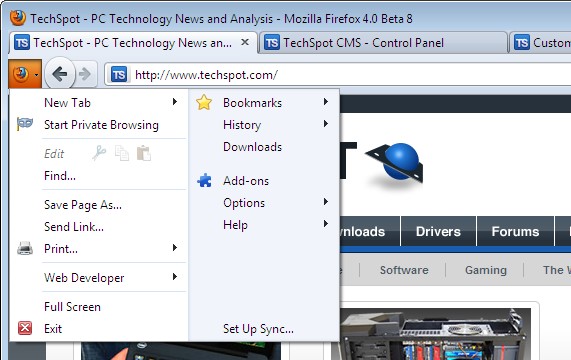
But of course Mozilla hasn't deviated from what's made Firefox the second most used browser in the world: flexibility. Here are some quick customization tricks you can use to help you tailor Mozilla’s browser closer to your needs.
Hi-tech accelerates the future of cars
CES is the place to be if you are a hi-tech firm with a gadget to unveil to the world.
In 2011, it was the place Ford chose to unveil a new car - the electric version of its Focus. It will be on sale in the US by the end of the year and Europe soon after.
Debuting the Focus at CES rather than the Detroit Motor Show indicates how important in-car electronics have become to every manufacturer and car owner.
"The most exciting innovations are not the ones happening in homes and offices, they are in cars," said Audi boss Rupert Stadtler. "These changes will link the way we drive with the way we live which until now have been separate."
Anyone who has bought a new car recently knows that those innovations have been making themselves felt for a while as manufacturers swap dials for digital displays and tachometers for touch screens.
Information driven  Audi's e-tron spyder concept car hints at the future of electric vehicles
 At CES the links between the computer world and the car world are laid bare. One example of the cross-connection was the deal Nvidia announced with both Audi and BMW to use its Tegra 2 chip to draw the 3D graphics on the instrument panels of future vehicles from both firms.
Low power chips such as Tegra 2 were only going to become more important as petrol is swapped for batteries, said Nvidia founder Jen-Hsun Huang.
"If you have barely any power you had best be miserly on energy consumption," he said, "because energy consumption directly relates to weight and that directly relates to fuel efficiency."
As he implies, the need to get the most out of a vehicle becomes acute if it is battery powered.
The limited range of electric vehicles and the time it takes to re-fuel means it will become essential for drivers to plan their route and know the location of charging stations before they set out.
Fuel stations litter most nations and anyone taking a drive in a petrol powered car can rely on finding one no matter where they go. The same is not true of charging stations and may not be for a long time. As of January 2011, there were only 1800 charging stations in the whole of the US. By contrast, there were more than 120,000 gas stations.
Ford is seeking to ease this information burden using apps for Apple and Android smartphones that future owners of their electric Focus will use to plan routes and find charging stations before the car runs out of juice.
Via the phone and the dashboard of the car, the app will tell drivers if they are driving efficiently or not. This is because those who are gentle on the brakes and accelerator will get many more miles from a full battery than those with a lead foot.
All this points up the fact that cars are rapidly becoming mobile databases awash with information about the vehicle, its surroundings and how it is being driven.
Social networking Venkatesh Prasad, technical leader of Ford's infotronics group, said in the future cars will know huge amounts about the lives of their drivers, the routes they take, their music tastes and where they go to shop and eat.
They were going to be able do this, he said, because of the huge amount of social network information people are getting happier to share. Including a car in the circle of friends who are party to this data could help the vehicle prepare itself for the "context" of each journey.
"That will help it understand your context," he said. "What you want before you get in, when you get and what changes when some passengers leave."
This could mean cueing up the music you like, storing podcasts of radio shows you may have missed or looking ahead to secure a parking spot in town.
The dawn of an age when cars can do this was very close, said Mr Prasad.
Smarter car Even now cars are fitted with sensors that make them far more adept on the road than their drivers.
 Modern cars know they are in a crash long before their occupants
 For instance, cars know a crash is taking place about seven milliseconds after initial impact as the pressure wave from the smash hits acceleration sensors. Many respond almost a millisecond later by tensioning seat belts, unlocking doors, rolling down windows and inflating airbags.
By contrast, a human will take up to 300 milliseconds just to realise another car has hit them let alone take any action.
These driver assistance systems are becoming standard on newer cars and there is a growing market in gadgets that add some of that intelligence to older vehicles.
At CES, MobileEye showed off a dashboard mounted camera that can warn of collisions several seconds before they happen or it can alert a driver if they straying out of their lane.
Taser showed off the Protector system that can, when paired with a mobile, stop a person calling or texting while driving. It is one of many similar gadgets that try to make driving safer.
Also at CES, inthinc showed off the Tiwi, a device that monitors a car's speed and location and relays the information to parents keen to keep an eye on where their offspring are going and how fast. It also delivers verbal warnings if it detects a car being driven faster than the speed limit or handled recklessly.
Todd Follmer, creator of the gadget, said it can also be programmed to recognise "geo-fences" and warn when a vehicle is taken beyond these virtual borders.
Developing Tiwi was not straightforward, said Mr Follmer, because there is little standardisation among manufacturers about the format of information sent over the data bus inside a car.
"It's mandated that diagnostic codes are published so anyone can work on your car," said Mr Follmer. "But a lot of the stuff we get is not standard. We have to reverse engineer what's on the bus to get at it."
His comments cut to the crux of the debate about the smarter cars we will all be driving in the future, how much they will know about us and what happens to that data - are we still in the driving seat?
Kevin Rose: iPad 2 Announced in 'Next 3-4 Weeks'
The Apple rumor mill has had a busy week. The latest report came Friday from Digg founder Kevin Rose, who said on his blog that the next iPad is imminent.
"I have it on good authority that Apple will be announcing the iPad 2 in the next '3-4 weeks,' possibly Tuesday February 1st.," Rose posted. "The iPad 2 will feature a retina display and front/back camera. If you're thinking of buying an iPad, hold off for now."
Other rumors that have been reported about the next iPad include that it will feature a USB port, a larger speaker, and slimmer design.
There is is other evidence that suggests Apple is gearing up for a potentially big announcement. On Thursday, AppleInsider said that Apple is limiting vacation time for its retail employees for a three-week period that starts at the end of January. The site said that Apple has held onto its "overstaffed holiday personnel at many retail stores" in anticipation of some high-profile product launches.
Despite Apple's embargo on vacation time, as usual, retail employees are kept in the dark about what products the company is planning and when they would be launched.
Rumors of the next-generation iPad have been cropping up frequently over the past few months. It was initially reported that Apple would break its traditional year-long update cycle and produce a second iPad in time for the holidays. However, that time passed and the device has yet to be revealed.
Is Apple also planning a Verizon iPhone? On Friday, Verizon sent out invitations for a Jan. 11 press event in New York City. This has prompted further speculation that Apple is finally breaking its exclusivity with AT&T and will produce a CDMA iPhone for Verizon.
AppleInsider also got ahold of photos of what it believes could be a new iPhone. The images are said to come from Foxconn, a Chinese electronics manufacturer that is part of Apple's supply chain. Although they aren't easy to decipher they could be the iPhone 4 for Verizon.
As for the iPad, which debuted last April, it could be logical to conclude its update is right around the corner. That is, if its assumed that Apple is sticking to its traditional update cycle of a year.
"I have it on good authority that Apple will be announcing the iPad 2 in the next '3-4 weeks,' possibly Tuesday February 1st.," Rose posted. "The iPad 2 will feature a retina display and front/back camera. If you're thinking of buying an iPad, hold off for now."
Other rumors that have been reported about the next iPad include that it will feature a USB port, a larger speaker, and slimmer design.
There is is other evidence that suggests Apple is gearing up for a potentially big announcement. On Thursday, AppleInsider said that Apple is limiting vacation time for its retail employees for a three-week period that starts at the end of January. The site said that Apple has held onto its "overstaffed holiday personnel at many retail stores" in anticipation of some high-profile product launches.
Despite Apple's embargo on vacation time, as usual, retail employees are kept in the dark about what products the company is planning and when they would be launched.
Rumors of the next-generation iPad have been cropping up frequently over the past few months. It was initially reported that Apple would break its traditional year-long update cycle and produce a second iPad in time for the holidays. However, that time passed and the device has yet to be revealed.
Is Apple also planning a Verizon iPhone? On Friday, Verizon sent out invitations for a Jan. 11 press event in New York City. This has prompted further speculation that Apple is finally breaking its exclusivity with AT&T and will produce a CDMA iPhone for Verizon.
AppleInsider also got ahold of photos of what it believes could be a new iPhone. The images are said to come from Foxconn, a Chinese electronics manufacturer that is part of Apple's supply chain. Although they aren't easy to decipher they could be the iPhone 4 for Verizon.
As for the iPad, which debuted last April, it could be logical to conclude its update is right around the corner. That is, if its assumed that Apple is sticking to its traditional update cycle of a year.
Apple's Mac App Store Hits One Million Downloads in First Day
That didn't take long. Apple has announced that its recently released Mac App Store—literally, launched on January 6, 2011—racked up more than one million app downloads within a 24-hour time period. The figure's even more impressive given that the store itself only launched with, "more than 1,000 apps," as opposed to, say, 50,000 or something--that's a lot of multiple app downloading.
"We're amazed at the incredible response the Mac App Store is getting," said Steve Jobs, Apple's CEO, in a press release distributed by the company. "Developers have done a great job bringing apps to the store and users are loving how easy and fun the Mac App Store is."
Evernote, makers of the identically named software that helps one keep track of to-do items, would have to agree with Jobs. According to the company, more than twice as many users have been signing up for its software using the Mac App Store than by previous methods, which includes both desktop and mobile downloads.
Richard Gaywood over at The Unofficial Apple Weblog slogged through 2,004 different apps (as found on the UK version of the store) in an attempt to generate deeper analytics as to what, exactly, makes up the core of Apple's app business. According to him, the predominant category in the Mac App Store is games, eating up around 600—or nearly one-third—of all programs present.
Utility-, productivity-, and entertainment-themed apps number around 200 apiece, but even this can be a bit of a misnomer, reports Gaywood. The Mac App Store might be set up into roughly 35 different categories of apps to download, but a number of apps can be found in multiple category listings.
As far as pricing goes—another eye-opener for those accustomed to paying $1 or so for apps for their various mobile Apple devices—most apps on the Mac App Store live within the category of apps priced at $5 or under. Less than 100 of the apps Gaywood surveyed are free, and slightly over 300 cost anywhere from $10 to $50.
Only a scant few apps, less than 20, push past $100 within Apple's Mac App Store. And of these, the most expensive application is Distribute—"a single user, purchase, inventory and sales manager built exclusively for Mac OS X," reads the app's description. Picking up one copy of this app will set you back $700.
"We're amazed at the incredible response the Mac App Store is getting," said Steve Jobs, Apple's CEO, in a press release distributed by the company. "Developers have done a great job bringing apps to the store and users are loving how easy and fun the Mac App Store is."
Evernote, makers of the identically named software that helps one keep track of to-do items, would have to agree with Jobs. According to the company, more than twice as many users have been signing up for its software using the Mac App Store than by previous methods, which includes both desktop and mobile downloads.
Richard Gaywood over at The Unofficial Apple Weblog slogged through 2,004 different apps (as found on the UK version of the store) in an attempt to generate deeper analytics as to what, exactly, makes up the core of Apple's app business. According to him, the predominant category in the Mac App Store is games, eating up around 600—or nearly one-third—of all programs present.
Utility-, productivity-, and entertainment-themed apps number around 200 apiece, but even this can be a bit of a misnomer, reports Gaywood. The Mac App Store might be set up into roughly 35 different categories of apps to download, but a number of apps can be found in multiple category listings.
As far as pricing goes—another eye-opener for those accustomed to paying $1 or so for apps for their various mobile Apple devices—most apps on the Mac App Store live within the category of apps priced at $5 or under. Less than 100 of the apps Gaywood surveyed are free, and slightly over 300 cost anywhere from $10 to $50.
Only a scant few apps, less than 20, push past $100 within Apple's Mac App Store. And of these, the most expensive application is Distribute—"a single user, purchase, inventory and sales manager built exclusively for Mac OS X," reads the app's description. Picking up one copy of this app will set you back $700.
Motorola Atrix 4G, Droid Bionic Plot Dual-core Course
Tablets may have defined the geeky gestalt of the 2011 Consumer Electronics Show, but the show will also be undoubtedly viewed as the coming-out party for smartphones and a tablet with dual-core processors.
Motorola's Atrix 4G handset, Droid Bionic smartphone and Motorola Xoom tablet will all run Nvidia Tegra 2 chips when they arrive within the next few months.
These devices feature two processors on a single die for up to 2 GHZ of processing power, or double that of current leading high-end smartphones on the market.
Consider that just 15 months ago the original Motorola Droid launched with a then-standard 550 MHZ chip. Two months after that, the Google Nexus One debuted with a 1GHZ chip, which became the new industry standard for Android smartphones.
Motorola is pushing the envelope again. EWEEK tested the processing speeds of the Atrix 4G, which is rolling out from AT&T in the first quarter, and the Droid Bionic, which Verizon Wireless will offer in the second quarter.
The test was done side-by-side with the 1GHZ-powered Motorola Droid X. Though the Droid X is no data-piping slouch, eWEEK noticed a marked drop in latency from the Droid X to the new devices.
In our opinion, the arrival of dual-core will date the 1GHZ phones.
Gartner analyst Ken Dulaney was less impressed, noting that dual-core is a foregone conclusion just as quad core will be some day.
"I don't consider it the revolution that many seem to think it is," Dulaney added. "It's happened on the PC side and it was logical to think that all processors would implement at least dual-core."
He also said he would surprised if the iPhone 5 next summer didn't come fueled by dual-core.
Independent analyst Jack Gold agreed that Apple will employ dual-core on its next-generation phone. He also said he wouldn't be surprised to see a quad-core ARM chip in the next 12 to 18 months, including from Apple.
"But of course, the mobile OSes would have to catch up and be able to utilize on all those cores to make it attractive to deploy them," Gold told eWEEK, adding that Android still really doesn't work on multi-core/multithread.
Now it remains to be seen what kind of pricing these speedier phones will get. Generally, a faster processor will yield a price bump.
Motorola Mobility CEO Sanjay Jha would only say at CES that the new phones will be come with "competitive" pricing. That usually means the devices will be priced to sell but comparable to others in the market.
But Motorola is the first to mass-market dual-core smartphones, so it can set the pricing.
The question is: will Motorola price these new phones at the high-end smartphone average of $199 with contract, or dip into the more risqué pool $200-plus phones, such as the $249 Samsung Epic 4G?
Current Analysis analyst Avi Greengart told Reuters that instead of a more pricey device, he expects a premium for data service.
We'll have to wait another month or two before Motorola and its carrier partners unveil the costs for these new dual-core smartphones and data plans.
Hard Drive Withstands Drops, Submersion, Shotgun Blasts
ioSafe's Rugged Portable hard drive launched at the Consumer Electronics Show this week withstood drops, submersion and even blasts from a 12-guage shotgun.
"It has a full metal jacket and it is machined out of a solid billet of aluminum," ioSafe CEO Robb Moore said.
"It has a full metal jacket and it is machined out of a solid billet of aluminum," ioSafe CEO Robb Moore said.
-
- 1diggdigg
-
- 7 Comments
- +30 Recommends
Hard Drive Withstands Drops, Submersion, Shotgun Blasts
ioSafe's Rugged Portable hard drive launched at the Consumer Electronics Show this week withstood drops, submersion and even blasts from a 12-guage shotgun.
"It has a full metal jacket and it is machined out of a solid billet of aluminum," ioSafe CEO Robb Moore said.
The drive ranges in size from 250GB to 1TB and is priced starting at US$150.
The case is waterproof and can protect the data for up to three days in salt or fresh water at a depth of 10 feet, or 30 feet in the case of the titanium SSD version. The aluminum drive can withstand drops from 10 feet and the titanium from 20 feet.
But the most impressive demonstration of the drive's durability was at a Las Vegas gun range where data was recovered after the drive was shot with six blasts from a 12-gauge shotgun. The outer case was peppered with buckshot but there was no loss of data. Moore never claimed the drive could withstand gun blasts but said the demonstration was a fun way to s how its durability.
From the arsenal then came an M16 automatic rifle capable of firing six rounds per second. One shot grazed the case, blowing off the back plate of the drive. If it had hit the center of the drive it would have been destroyed but because it hit only the side the photos Moore had loaded earlier could still be viewed.
The rugged drive has USB 3.0 and FireWire connections. Any model purchased comes with one year of data recovery service. Three years costs $50 and five years costs $100. The service includes data recovery even in cases of accidental deletion, according to ioSafe.
ioSafe has promoted other rugged hard drives. Last year, the company introduced the ioSafe Solo, which survived a flame cannon and submersion in water. (See the video of those unsuccessful demolition attempts.)
"It has a full metal jacket and it is machined out of a solid billet of aluminum," ioSafe CEO Robb Moore said.
ioSafe Shootout Video
The drive ranges in size from 250GB to 1TB and is priced starting at US$150.
The case is waterproof and can protect the data for up to three days in salt or fresh water at a depth of 10 feet, or 30 feet in the case of the titanium SSD version. The aluminum drive can withstand drops from 10 feet and the titanium from 20 feet.
But the most impressive demonstration of the drive's durability was at a Las Vegas gun range where data was recovered after the drive was shot with six blasts from a 12-gauge shotgun. The outer case was peppered with buckshot but there was no loss of data. Moore never claimed the drive could withstand gun blasts but said the demonstration was a fun way to s
how its durability. From the arsenal then came an M16 automatic rifle capable of firing six rounds per second. One shot grazed the case, blowing off the back plate of the drive. If it had hit the center of the drive it would have been destroyed but because it hit only the side the photos Moore had loaded earlier could still be viewed.
The rugged drive has USB 3.0 and FireWire connections. Any model purchased comes with one year of data recovery service. Three years costs $50 and five years costs $100. The service includes data recovery even in cases of accidental deletion, according to ioSafe.
ioSafe has promoted other rugged hard drives. Last year, the company introduced the ioSafe Solo, which survived a flame cannon and submersion in water. (See the video of those unsuccessful demolition attempts.)
Smartphone users face confusion
Things are about to get even more confusing for smart phone shoppers.
This year will be the year that 4G networks — the industry term for a next-generation network that provides broadband speeds or faster over a wireless connection — start landing in consumers' pockets in earnest.
Unfortunately, cell-phone companies have blurred the lines when it comes to 4G. They all now are using the 4G moniker, but the networks are very different.
"All 4G is not created equal," Lowell McAdam, Verizon president and chief operating officer, said Thursday at the Consumer Electronics Show in Las Vegas.
The result: Users, who genuinely want a faster smartphone experience, are left awash in acronyms as they weigh a phone upgrade or carrier switch.
"The industry uses a lot of technology-based definitions that don't mean much to consumers," said Don Kellogg, senior manager of telecommunications research and insights for Nielsen, who recently studied consumer confusion over the term 4G. "People want to know how is this going to benefit them."
Different standards
—T-Mobile uses a wireless standard called HSPA+, which the company is advertising as 4G.
—Verizon Wireless is using a technology called Long-Term Evolution, widely seen as the faster standard, to deliver its 4G network.
— T-Mobile said Thursday that it would be able to double the speed of its HSPA+ network this year through software enhancements.
— AT&T confuses things even more, by deciding to start this year with an HSPA+ roll-out before eventually upgrading to an LTE standard similar to Verizon's by year end. They'll call the network 4G the whole way through.
—Sprint uses another standard yet for its 4G network called WiMax.
To complicate things even further, if you were to follow the initial 4G standard set by the International Telecommunication Union, none of these networks would be worthy of the 4G moniker.
Faced with an entire slate of wireless carriers advertising these LTE and HSPA networks as 4G, the ITU eventually caved.
New smartphones
Verizon, which hadn't released a smartphone capable of accessing the carrier's 4G LTE network, revealed four smartphones Thursday: the HTC ThunderBolt, the LG Revolution, the Droid Bionic 4G and the Samsung 4G LTE Smartphone. All the phones have 4.3-inch touchscreens. The carrier also revealed a 4G-compatible version of the popular Samsung Galaxy Tab tablet.
All the products will be available in the first half of the year, with some coming as early as March, said Marni Walden, chief marketing officer at Verizon.
AT&T said it would release 20 4G devices in 2011, the first batch working with HSPA+ and the second batch working with LTE. If you buy one of those first HPSA+-based 4G phones, you'll be unable to access the faster LTE speeds when that launches later this year.
A study from Nielsen released Thursday to coincide with all the carrier 4G announcements showed that many consumers don't understand what the next-generation network name means.
While 4 in 5 consumers are aware of the term 4G, only 2 of those 4 understand what it means, the study showed.
Reports: Verizon appears poised to offer iPhone
Verizon Wireless finally appears poised to offer its customers the iPhone
Verizon has scheduled a press conference in New York on Tuesday to make an announcement. The Wall Street Journal reported on Friday that the nation's largest wireless carrier will unveil its own version of the iconic smartphone, ending the exclusive distribution arrangement that Apple has had since 2007 with AT&T.
The Verizon phone will be similar to iPhone 4 but run on the carrier's CDMA technology, according to the Journal report which cited "a person familiar with the matter." It isn't clear when Verizon devices will be in stores.
Reuters also reported Verizon's iPhone announcement plan, citing an unnamed source. USA TODAY could not confirm the report.Verizon and Apple declined to comment.
An agreement between Apple and Verizon could boost iPhone sales. Many Verizon customers who want the phone did not want to switch to AT&T, which has been plagued with reports of dropped calls in cities including New York and San Francisco.
But a Verizon iPhone could hurt Sprint Nextel and T-Mobile USA which do not have deals to offer the iPhone.
The move to expand iPhone carriers beyond AT&T comes as Apple faces growing competition from phones based on Google's Android operating system. Google had no comment on the Verizon-iPhone reports.
Rumors of iPhone coming to Verizon have swirled for two years. They increased in intensity as sales of Android-based phones grew. They collectively eclipsed iPhone in mid-2010, according to market researcher Gartner.
That provoked Apple CEO Steve Jobs to criticize Android as "fragmented" in a rare appearance on a conference call with analysts in October.
Apple faced a choice of lowering the price on AT&T's iPhones, or adding Verizon to the mix, mobile analysts say.
"If I'm Apple's board and I want to find a way to make a lot of money with little effort, I launch Verizon," says Ken Dulaney, an analyst at Gartner. "There is great momentum to move away from AT&T, given their dissatisfaction with AT&T's (balky) service."
Apple's deal with AT&T initially helped it reach a large audience. But its exclusivity helped Google to sell Android devices on all carriers, says Gene Munster, an analyst at Piper Jaffray. "As soon as Verizon gets iPhone, it will reverse the trend of Android gains," Munster says. "iPhone will sell well vs. Android phones when given the chance."
AT&T accounts for about 10% of Apple's business, Munster says. Apple sold 14.1 million iPhones in its fourth quarter, ended Sept. 25.
الجمعة، 7 يناير 2011
Google Apps adds anti-spam: Student email war continues
Google Apps will now contain an anti-spam feature using Domain Keys Identified Mail (DKIM) to sign outgoing messages as a method of authentication. Ordinary Gmail has had this for some time, but Google Apps has finally caught up.
This means users of Google Apps, including school and university users have the option, if their organisation supports it, to add an extra layer of protection to their inboxes enabling their messages to easily slip through Google’s spam filter.
In short, it means more genuine emails will pass through the spam filters unharmed and dejunked.

But Microsoft’s competing and succeeding email client, Live@edu does not support lacking this industry in their cloud offering, where a non-hosted Exchange server does. But Live@edu, soon to be Office 365 for Education, has another trick up its sleeve instead.
This means users of Google Apps, including school and university users have the option, if their organisation supports it, to add an extra layer of protection to their inboxes enabling their messages to easily slip through Google’s spam filter.
In short, it means more genuine emails will pass through the spam filters unharmed and dejunked.
But Microsoft’s competing and succeeding email client, Live@edu does not support lacking this industry in their cloud offering, where a non-hosted Exchange server does. But Live@edu, soon to be Office 365 for Education, has another trick up its sleeve instead.
Facebook Versus Google Circa 2004
Is Facebook worth $50 billion? As people ponder that question this week, we decided to look at Google, the Internet’s previous wunderkind.


Google’s market cap passed the $50 billion mark in October 2004. The company was exactly six years old—Facebook turns seven next month—and had just announced quarterly revenue of $806 million, up 105% from the same period a year earlier.
Through the first nine months of 2004, Google reported revenue of $2.2 billion and net income of $195 million. Through the first nine months of 2010, Facebook’s revenue was about $1.2 billion and its income was $355 million, The Wall Street Journal reported, citing a citing a private-placement memo being distributed to potential investors in the company.
For all of 2009, Facebook’s revenue was $777 million and its income was $200 million. Google in 2003—the similar year in the search giant’s history—reported revenue of $1.5 billion and a profit of $106 million.
So there you have it. Google’s revenue was higher, but it wasn’t as profitable as Facebook. Also, it looks like Facebook is growing a little faster than Google was at the time.
The math in this comparison is admittedly fuzzy, and comparing a social network to a search engine isn’t exactly online apples to apples. But does knowing Google was worth $50 billion change how you feel about Facebook’s valuation?
Google battles Derby cops over access to Street View data
Google has turned the boys in blue red with rage by refusing to hand over private data without a court order.
Police want to trace a vehicle snapped by Google's Street View cameras next to a caravan that was stolen shortly afterwards.

The thief struck in June 2009, while the Soanes family, from Linton, Derbyshire, were out. The police investigation stalled until March 2010, when 11-year-old Reuben found the family home on Street View and saw and the unidentified 4x4 and its driver had been captured on the driveway.
A public appeal for information was issued in November, using the the publicly available version of the photograph, in which the number plate of the 4x4 is automatically blurred by Google to comply with privacy laws. At the same time police asked for the non-anonymised version, but were rebuffed.
It apparently drew no leads, and now Derbyshire Police are pressing Google to release the image without the inconvenience of obtaining a court order.
Investigators have roped in local Tory MP Heather Wheeler to put pressure on the search giant to bend its rules.
"I am disappointed that Google's initial reaction is to refuse," she told the Derby Telegraph.
"It would be sensible for them to enter into a protocol with British police forces to receive and acquiesce to police requests. Of course, the police can get a court order but what a waste of public money in order to do that."
Google remains unmoved however.
"It's very important to Google and our users that we only provide information if valid process is followed, as laid down by governments in law," it said in a statement.
"We have a team specifically trained to evaluate and respond to requests when they are received, and we will of course co-operate with police requests as long as they are legally valid and follow the correct processes."
The rules on when authorities require court backing to obtain private data vary. Most notably for a company such as Google, under the Regulation of Investigatory Powers Act, intelligence agencies and police can obtain communications data – records of who communicated with whom, when, where and how, but not of what was said – without routine outside scrutiny.
Android Edges iPhone in U.S. Smartphone Market: ComScore
Smartphones bearing Google's Android operating system surpassed Apple iOS in the U.S., grabbing 26 percent to Apple's 25 percent share through the three-months ending in November 2010.
ComScore found that puts Android at No. 2 behind market leader RIM's Blackberry OS share, which slipped to 33.5 percent from 35.8 percent through October. Blackberry, whose share was 37.6 percent in August, continues to see declining share at the hands of Android and iOS.
RIM's fall is concerning for the Canadian smartphone maker. Microsoft's Windows platform share also fell 1.8 percent to 9 percent through November, as Windows Phone 7 devices try to gain traction.
While Apple grew share to 25 percent from 24.6 percent through October, it may have the greatest cause for concern here. Android's share had yet to crack 19.6 percent through August, while iOS commanded 24.2 percent share at that time.
ComScore's new numbers show Android gained 6 percentage points of share since the end of the summer, while iOS grew less than 1 percent, no doubt on the strength of a strong iPhone 4 offering.
While Apple was absent from the 2011 Consumer Electronics Show, Google's Android operating system drew strong interest, thanks to 4G smartphone announcements from Motorola and Samsung.
These rivals will ship devices powered by Verizon Wireless' speedy new broadband network later this year.
Android's swift rise and iPhone's modest growth make it an iPhone launch on Verizon Wireless all the more crucial for Apple, which is expected to do just that this quarter. Expect an additional iPhone refresh this summer to challenge Android handsets.
Samsung meanwhile enjoyed 24.5 percent of U.S. mobile subscribers. LG ranked second with 20.9 percent share, followed by Motorola at 17.0 percent, RIM at 8.8 percent and Nokia at 7.2 percent.
Overall, 61.5 million people in the U.S. owned smartphones during the three months ending in November, up 10 percent from the prior three-month period.
The pie continues to grow larger for phone makers, which are jockeying for greater pieces of it.
Apple CEO Jobs' 2010 compensation remains $1
A regulatory filing shows Apple CEO Steve Jobs' compensation package remained the usual $1 in fiscal 2010.
Apple Inc. said in a filing with the Securities and Exchange Commission on Friday it paid a salary of $1 to Jobs, who rejoined Apple in 1997 and has overseen the company's unrivaled successes with the iPod, the iPhone and now the iPad.
As is customary, Jobs got no bonus or perks. Apple says it reimbursed Jobs $248,000 for travel on his personal jet. But Jobs holds 5.5 million of Apple's shares, which gained about 60 percent in value during the fiscal year.
The Associated Press compensation calculation includes salary, bonus, performance-related bonuses, perks, above-market returns on deferred compensation and the estimated value of stock options and awards granted during the year.
Skype Acquires Qik for $100 Million [CONFIRMED]
Skype has acquired video streaming service Qik, the company announced at the Consumer Electronics Show (CES) in Las Vegas.
Skype CEO Tony Bates confirmed the announcement on the company blog ( ): “I’m happy to announce that we’ve entered into a definitive agreement to acquire Qik,” he wrote.
The news was first leaked by Business Insider Thursday morning. The source who revealed the news claims that the deal cost Skype () approximately $100 million.
Qik allows users to host two-way live video calls on a range of smartphones, as well as record and share video via e-mail, SMS, Twitter (), Facebook (), YouTube () and a number of other platforms.
Qik’s userbase catapulted to 5 million users in 2010, up from 600,000 at the beginning of the year, thanks in part to partnerships with major telecom providers like T-Mobile.
“Skype and Qik share a common purpose of enriching communications with video, and the acquisition of Qik will help to accelerate our leadership in video by adding recording, sharing and storing capabilities to our product portfolio,” Bates wrote. “Through this acquisition, we’ll also be able to take advantage of the engineering expertise that is behind Qik’s Smart Streaming technology, which optimizes video transmission over wireless networks,” he added.
Skype and Qik have two important board members in common: Marc Andreessen and Ben Horowitz, who could have helped facilitate the deal.
Skype CEO Tony Bates confirmed the announcement on the company blog (
): “I’m happy to announce that we’ve entered into a definitive agreement to acquire Qik,” he wrote.The news was first leaked by Business Insider Thursday morning. The source who revealed the news claims that the deal cost Skype () approximately $100 million.
Qik allows users to host two-way live video calls on a range of smartphones, as well as record and share video via e-mail, SMS, Twitter (), Facebook (), YouTube () and a number of other platforms.
 )
)Qik’s userbase catapulted to 5 million users in 2010, up from 600,000 at the beginning of the year, thanks in part to partnerships with major telecom providers like T-Mobile.
“Skype and Qik share a common purpose of enriching communications with video, and the acquisition of Qik will help to accelerate our leadership in video by adding recording, sharing and storing capabilities to our product portfolio,” Bates wrote. “Through this acquisition, we’ll also be able to take advantage of the engineering expertise that is behind Qik’s Smart Streaming technology, which optimizes video transmission over wireless networks,” he added.
Skype and Qik have two important board members in common: Marc Andreessen and Ben Horowitz, who could have helped facilitate the deal.
Hands On: NEC LT-W Dual-Screen Tablet
Tablets are all the rage at CES 2011, and Japanese company NEC has jumped into the fray with the LT-W Cloud Communicator, a slate with dual touchscreens that unfolds like a book and runs Android 2.1.
Don't get too excited, though — it's not coming to market anytime soon. NEC reps told PCMag that the tablet would be first introduced in Japan, probably in the next six months, and there are currently no formal plans to take it anywhere else. NEC is a system designer/manufacturer, and licenses its products to other companies to bring them to market, so if and when the tablet comes out, it in all likelihood won't have the NEC brand.
I dropped by the NEC booth to get some quality time with a prototype LT-W (which company reps tell us is NOT called the LifeTouch, despite reports to the contrary, including an early version of this one), and came away with grudging respect. The dual 7-inch touchscreens are resistive, not capacitive like most smartphones and other tablets. Thus the touch interface wasn't as senisitive as I would have liked, but it was still better than I expected (an… ugh… stylus is provided for users that have trouble). The TFT LCDs were definitely more muted than your typical LCD, looking more like color E Ink (which could be a good thing for many applications).
The LT-W's ARM Cortex A8 processor did a good job of keeping up with my button pressing, app switching, and Web surfing, though I didn't try out any video. It's easy to switch most apps from a single screen to spread across both screens, allowing you to double your screen space (nice for the drawing app) or help you see things closer by putting a full image on the left with a zoomed portion on the right.

It looks a little hefty but only weighs 1.2 pounds, or about six ounces less than an iPad. Closed, it's about an inch thick. The three hard buttons and navigation pad, which are on the bottom of the left side, definitely feel less elegant than a Droid phone, but remember this is a prototype.
Final judgment on the LT-W Cloud Commuincator really depends on the price, which hasn't been determined, and what it'll be used for. NEC reps said they didn't have a specific target customer for the tablet, leaving that open to their partners, but they did mention schools and hospitals as likely places it'll end up first.
Rounding out the specs:
• Each screen is 800 x 600
• WiFi is 802.11b/g
• Bluetooth 2.1
• SDHC card slot and USB port
• Mono speaker
• GPS and accelerometer built-in
• Each screen is 800 x 600
• WiFi is 802.11b/g
• Bluetooth 2.1
• SDHC card slot and USB port
• Mono speaker
• GPS and accelerometer built-in
CES Count the Tablets 1 & 2: Sharp Galapagos
LAS VEGAS - Since Microsoft managed to avoid mentioning anything about Windows tablets during CEO Steve Ballmer’s CES keynote, we are kicking off our “Count the Tablets” coverage of CES with two Android tablets from Sharp being marketed under the name Galapagos — 5.5” and 10.8” models are being shown at the trade show.
The 10.8” model features a resolution of 1366 x 800 (higher than Apple’s iPad, which is a 9.7” display at 1024 x 768), and the company is billing the ability to share content between multiple Sharp Android devices as a top feature. Sharp also said that it is a low power consumption device, though the company wasn’t specifying battery life.

The 10.8” Sharp Galapagos
In addition, Sharp said that users will be able to stream video content from the Galapagos to a TV through a proprietary technology. Some Sony TVs will come with built-in support for this technology, and Sharp is planning to release some kind of adapter kit for use on other TVs.
The company is also pushing a technology called XMDF for ebooks and other content that Sharp said will automatically reformat said content for the particular device it is being displayed on. This will be particularly handy for the Android world, which lacks anything resembling standards for display sizes or other elements of the devices.
Galapagos devices are scheduled to be released in the U.S. sometime in the second half of 2011, and Sharp hasn’t yet announced pricing. Jeff Gamet, on hand in Las Vegas at CES, found the devices to “feel cheap.”
The image below is the 5.5” model, which Sharp is intending to feel more like a book than the larger “home type” (the company’s words from a press release in September, 2010) 10.8” model.
The 5.5” Sharp Galapagos
RIM seeks 2 years to address India email security: report
BlackBerry-maker Research In Motion (RIM) wants 18-24 months to address security concerns raised by Indian agencies who have been demanding access to its corporate email services, two newspapers reported on Friday.
The Economic Times and Mint cited minutes of a meeting between the company, the government and security officials held on December 29 as their source.
RIM had denied on Thursday it was planning to provide access to data transmitted through Blackberry Enterprise Server.
"RIM reaffirms that any suggestion that it is enabling, or planning to enable in any time frame, access to data transmitted through BlackBerry Enterprise Server (BES) is both false and technologically infeasible," it had said in a statement.
The company's dealings with the government were positive and on track, it had said.
India has threatened to shut off BlackBerry Messenger and corporate email services unless it gains access to them, in a campaign driven by fears that unmonitored communication puts the country's security at risk.
RIM averted a ban last year, and the Indian government said in late October that RIM had set up an interim arrangement for lawful interception of BlackBerry Messenger services and assured a final solution by the end of January 2011.
The Economic Times and Mint cited minutes of a meeting between the company, the government and security officials held on December 29 as their source.
RIM had denied on Thursday it was planning to provide access to data transmitted through Blackberry Enterprise Server.
"RIM reaffirms that any suggestion that it is enabling, or planning to enable in any time frame, access to data transmitted through BlackBerry Enterprise Server (BES) is both false and technologically infeasible," it had said in a statement.
The company's dealings with the government were positive and on track, it had said.
India has threatened to shut off BlackBerry Messenger and corporate email services unless it gains access to them, in a campaign driven by fears that unmonitored communication puts the country's security at risk.
RIM averted a ban last year, and the Indian government said in late October that RIM had set up an interim arrangement for lawful interception of BlackBerry Messenger services and assured a final solution by the end of January 2011.
Nvidia To Build ARM-Based Microprocessor
Nvidia's plans to build an ARM-based microprocessor reflects changes in the computer industry that could threaten the dominance of Intel and Advanced Micro Devices in the general purpose computing market.
Nvidia announced Wednesday the existence of Project Denver, codename for its scheme to build an ARM-based central processor for personal computers, servers, workstations, and supercomputers. Nvidia President and Chief Executive Jen-Hsun Huang made the announcement at the Consumer Electronics Show in Las Vegas, Nev.Nvidia's ambitions were made possible by Microsoft. On the same day as the Nvidia announcement, the software maker said at CES that the next version of Windows would run on ARM-based microarchitectures, as well as x86 processors from Intel and AMD. Microsoft has not said when it would release the new operating system, which industry observers say is unlikely before 2012.
Microsoft is adding ARM to Windows because the technology developed and licensed by U.K.-based ARM Holdings is in nearly all smartphones and tablets. Microsoft is apparently unwilling to bet that Intel will topple ARM as the chipmaker tailors its x86 architecture for the mobile market.
Nvidia's ambitions in general purpose computing are seen by analysts as a logical extension of its current work in high-performance computing. The company has developed graphics processors that are used in supercomputers for scientific applications requiring huge amounts of number crunching. The world's fastest computer, China's Tianhe-1A, uses both Nvidia GPUs and Intel CPUs.
Nvidia also has experience in building ARM-based CPUs, which the company uses along with its graphics processors in its Tegra system-on-a-chip for smartphones and tablets. "Tegra is the little brother of Denver," Jon Peddie, analyst for Jon Peddie Research, told InformationWeek Thursday.
Scaling Nvidia's low-power CPU to drive servers and desktops, and then convincing computer makers to ship products with the hardware is going to take time, assuming Nvidia is successful. "It's going to take years for that to unfold," Shane Rau, analyst for IDC, says.
Nvidia's planned invasion of Intel's territory comes as the chipmaker is trying to grab a bigger share of the graphics market, putting pressure on Nvidia to expand its business. Intel officially launched at CES this week a chip design codenamed Sandy Bridge that combines a CPU with a GPU on the same piece of silicon. AMD announced at CES a similar architecture that it calls "accelerated processing units." Manufacturers have already announced plans to ship PCs using the new processors this year.
CES 2011: Motorola Atrix, Sony 3D TVs highlight day 1 in Las Vegas
Today is the first full official day of the 2011 Consumer Electronics Show, after kicking off with a keynote from Microsoft chief executive Steve Ballmer last night. You can check out Rob's live-blog of the keynote here.
Looking ahead to today, a lot of buzz will likely be about mobile and the move to 4G.
Verizon will be holding a press conference at 1 p.m., where they're expected to talk about what their 4G plans are. They'll likely announce the much-leaked HTC Thunderbolt, which advertises itself as the first 4G phone on Verizon and maybe 4G phones from Motorola and Samsung as well. There's a lot of speculation over whether or not they'll be announcing an iPhone for Verizon -- sneaking a little bit of Apple into CES after all.
Poll: What gadgets do you have your eye on at CES 2011?
Another highlight of the Consumer Electronics Show 2011 opening ceremonies was the announcement of T-Mobile and LG's G-slate tablet. Hayley Tsukayama has a first look at the G-slate:
T-Mobile sent out a first look at the Android-powered G-Slate by LG. According to the press release from T-Mobile, the G-Slate will be the first 4G tablet from the two companies running Android 3.0, or Honeycomb. It will feature a bevy of Google applications such as Google Maps 5.0 with 3-D interaction, a collection of more than 3 million eBooks and Google Talk with video chat.
Intel to Integrate DirectX 11 in Ivy Bridge Chips
Intel will integrate DirectX 11 graphics technology in its next generation of laptop and desktop chips based on the Ivy Bridge architecture, a company executive said on Thursday.
DirectX 11 includes a set of tools that can generate more realistic images when playing games on PCs running Windows 7. Intel will integrate the technology in next-generation laptop and desktop chips, as use of the technology in applications will spread by then, said Mooly Eden, vice president and general manager of the PC Client Group at Intel, in an interview on Thursday with the IDG News Service during the Consumer Electronics Show in Las Vegas.
That puts Intel a full generation behind Advanced Micro Devices on DirectX technology. AMD has already implemented DirectX 11 in its Fusion low-power chips, which were officially announced on Tuesday. Like Intel's most recent chips, the Fusion chips combine the graphics processor and CPU in a single piece of silicon.
Intel expects to start shipping Ivy Bridge chips with DirectX 11 support to PC makers late this year. Ivy Bridge will succeed the recently announced Core i3, i5 and i7 chips, which are based on Intel's Sandy Bridge microarchitecture. Intel releases a new generation of laptop and desktops chips every year, so the Ivy Bridge chips could reach consumers early next year.
The new Core chips based on Sandy Bridge integrate the older DirectX 10.1. Intel didn't feel the need to integrate DirectX 11 in the recently released chips as few applications currently take advantage of that graphics technology, Eden said.
"When we look at the schedule, we didn't think it was... the right time," Eden said. "There's not much usage."
Besides improving graphics, DirectX 11 harnesses the parallel-processing capabilities of CPUs and graphics processors to improve gaming and application performance.
Intel will make the Ivy Bridge chips using a 22-nanometer manufacturing process. The Ivy Bridge chips will be smaller and more power efficient than the Sandy Bridge chips, which are made using a 32-nm process.
The Sandy Bridge chips are the first in which Intel has combined a graphics processor and CPU on a single piece of silicon. The chips also include specialized decoders and accelerators to quicken multimedia file playback and conversion.
DirectX 11 includes a set of tools that can generate more realistic images when playing games on PCs running Windows 7. Intel will integrate the technology in next-generation laptop and desktop chips, as use of the technology in applications will spread by then, said Mooly Eden, vice president and general manager of the PC Client Group at Intel, in an interview on Thursday with the IDG News Service during the Consumer Electronics Show in Las Vegas.
That puts Intel a full generation behind Advanced Micro Devices on DirectX technology. AMD has already implemented DirectX 11 in its Fusion low-power chips, which were officially announced on Tuesday. Like Intel's most recent chips, the Fusion chips combine the graphics processor and CPU in a single piece of silicon.
Intel expects to start shipping Ivy Bridge chips with DirectX 11 support to PC makers late this year. Ivy Bridge will succeed the recently announced Core i3, i5 and i7 chips, which are based on Intel's Sandy Bridge microarchitecture. Intel releases a new generation of laptop and desktops chips every year, so the Ivy Bridge chips could reach consumers early next year.
The new Core chips based on Sandy Bridge integrate the older DirectX 10.1. Intel didn't feel the need to integrate DirectX 11 in the recently released chips as few applications currently take advantage of that graphics technology, Eden said.
"When we look at the schedule, we didn't think it was... the right time," Eden said. "There's not much usage."
Besides improving graphics, DirectX 11 harnesses the parallel-processing capabilities of CPUs and graphics processors to improve gaming and application performance.
Intel will make the Ivy Bridge chips using a 22-nanometer manufacturing process. The Ivy Bridge chips will be smaller and more power efficient than the Sandy Bridge chips, which are made using a 32-nm process.
The Sandy Bridge chips are the first in which Intel has combined a graphics processor and CPU on a single piece of silicon. The chips also include specialized decoders and accelerators to quicken multimedia file playback and conversion.
Android On Tablets Shows Why There's No Reason For Chrome (GOOG)
Google's new version of Android for tablets had its coming out party this week at CES, and demos like this one make it clear that there's absolutely no reason for Google to keep investing in its other operating system, Chrome OS.
Android 3.0 (codenamed Honeycomb) will show up on the Motorola Xoom and a bunch of other tablets in the next few months, and while Google isn't showing all the details yet, the new browser looks exactly like Chrome, with a tabbed interface that fills the whole screen, bookmarks, and privacy mode.
Except with Android, you're not forced to run everything in the browser. Google is also showing off a bunch of apps that run as widgets on the desktop, including Gmail, video chat, a books app, and the updated version of Google Maps. Plus, there are thousands of other Android apps already available, and an army of developers to build more.
There are differences between the two operating systems: Android is built for touch, while Chrome OS is meant to be used with a keyboard and pointer. That might have been a good idea two years ago, before the iPad came out and touch-screen tablets started to take off. Now it looks old and limited. And it hasn't even launched yet.

Android 3.0 (codenamed Honeycomb) will show up on the Motorola Xoom and a bunch of other tablets in the next few months, and while Google isn't showing all the details yet, the new browser looks exactly like Chrome, with a tabbed interface that fills the whole screen, bookmarks, and privacy mode.
Except with Android, you're not forced to run everything in the browser. Google is also showing off a bunch of apps that run as widgets on the desktop, including Gmail, video chat, a books app, and the updated version of Google Maps. Plus, there are thousands of other Android apps already available, and an army of developers to build more.
There are differences between the two operating systems: Android is built for touch, while Chrome OS is meant to be used with a keyboard and pointer. That might have been a good idea two years ago, before the iPad came out and touch-screen tablets started to take off. Now it looks old and limited. And it hasn't even launched yet.
Mac App Store Attacked By Hackers
It's only been open for about 24 hours, but Apple's online Mac App Store has already been hit by hackers, according to reports.
One well-known group, which operates under the name "Hackulous", claims it's developed a program, called Kickback, that breaks the copy protection in applications distributed through the Mac App Store. A spokesman for the group who goes by the name "Dissident" told the BBC that Hackulous will wait until the Mac App Store is well stocked with apps before it releases Kickback on the Internet. "We're not going to release Kickback until well after the store's been established. We don't want to devalue applications and frustrate developers," Dissident said, according to the BBC.
Software pirates have also reportedly found that paid apps downloaded from the Mac App Store can, in some cases, run free of charge simply by copying and pasting in the receipt number from a free app
The company opened the Mac App Store Thursday, with an eye to recreating the successful iPhone app distribution model on the Mac. The store is now available to shoppers in the U.S. and 89 other countries. There's apps—both paid and free—in a number of categories, including games, education, graphics & design, lifestyle, productivity, and utilities.
"With more than 1,000 apps, the Mac App Store is off to a great start," said Apple CEO Steve Jobs, in a statement. "We think users are going to love this innovative new way to discover and buy their favorite apps," said Jobs.
To download the Mac App Store client software, users need ensure they're running Mac OS X (Snow Leopard) v10.6.6. As with the iPhone store, developers who sell their apps through the Mac App Store will get to keep 70% of the profits. They also do not have to pay any hosting, marketing, or credit card processing fees.
"With more than 1,000 apps, the Mac App Store is off to a great start," said Apple CEO Steve Jobs, in a statement. "We think users are going to love this innovative new way to discover and buy their favorite apps," said Jobs.
To download the Mac App Store client software, users need ensure they're running Mac OS X (Snow Leopard) v10.6.6. As with the iPhone store, developers who sell their apps through the Mac App Store will get to keep 70% of the profits. They also do not have to pay any hosting, marketing, or credit card processing fees.
الاشتراك في:
الرسائل (Atom)